How to Find the Most Detailed Article on Any Subject
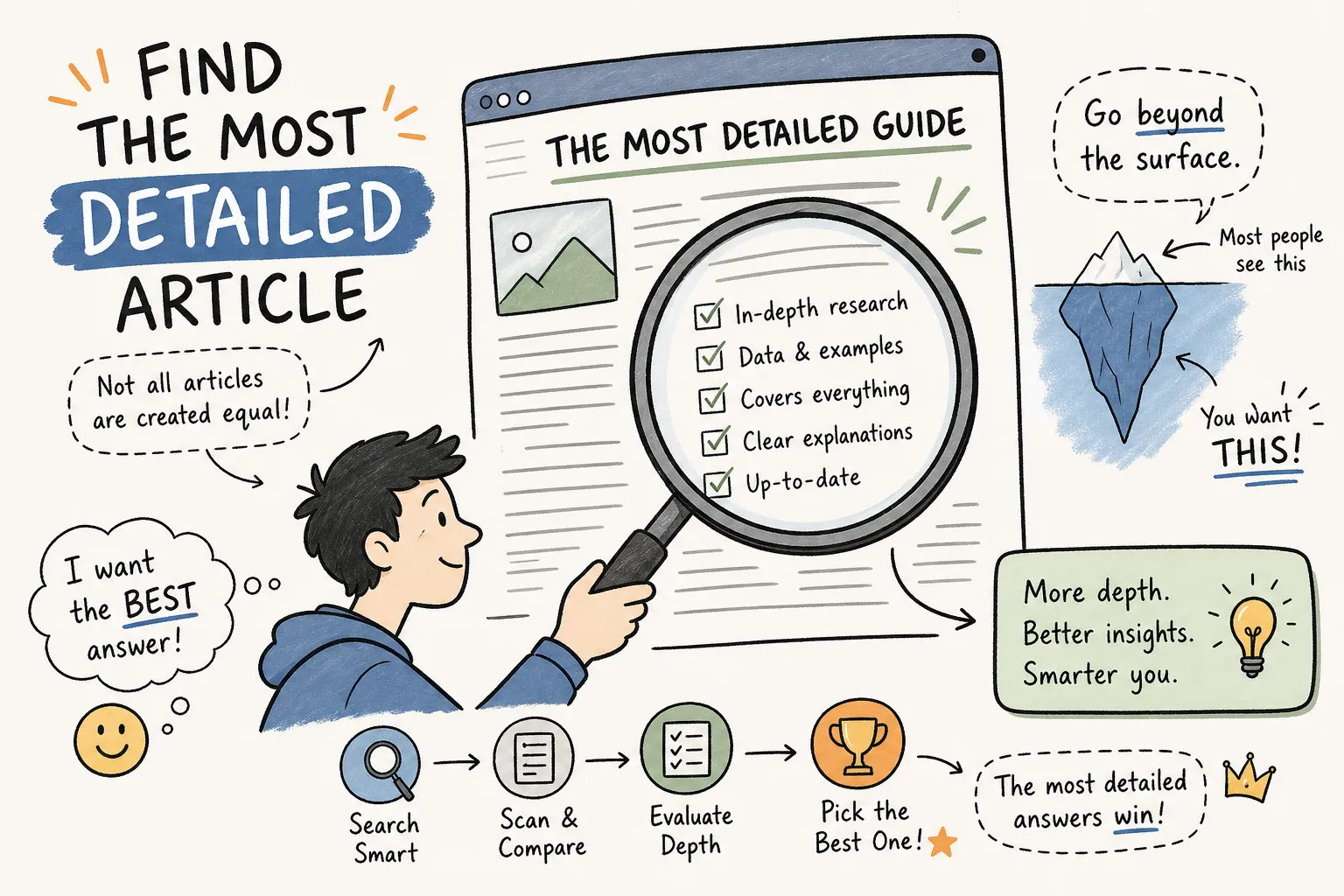
If you've ever wondered how do I find the most detailed article on a subject, you're not alone, and you're not doing anything wrong. You search a topic, skim five articles, and walk away with the same handful of facts repeated in slightly different words. Nothing goes deep. Nothing answers the follow-up questions forming in your head. The cause is built into how search engines rank content: they reward popularity, not depth.
Search algorithms reward engagement signals, backlinks, and formatting, not comprehensiveness. A clean 800-word overview can often outrank a 6,000-word authoritative study because the shorter piece earns more clicks, shares, and inbound links. This means the most detailed article on any given subject is almost never the first result you see. It's somewhere else, and finding it takes a more deliberate method.
SuperCharged Wiki was built to close this gap. For each topic it merges every Wikipedia language edition into one English article, with each paragraph marked by the editions it comes from, so the depth is already assembled when you arrive. The wider toolkit for finding in-depth articles goes further, and it is worth knowing.
Why the First Search Result Is Almost Never the Most Complete One
The Depth Problem with Default Search Results
Search engines are relevance engines tuned to surface what users engage with most, and users tend to engage with short, readable, well-formatted pages rather than long, citation-heavy ones. A well-structured listicle with strong SEO will reliably beat a comprehensive review article in the rankings, even when the review contains ten times the substantive information. As a result, the top results often share the same small pool of sources, the same core facts, and the same surface-level framing.
Search for almost any historical event and you'll see this pattern. The top results cover the same dates, the same key figures, and the same outcome. The context, the contested interpretations, and the regional dimensions sit on page four, or inside a database most readers never open.
How Language Determines What Information You Can Access
The information landscape is not equal across languages. Wikipedia exists in over 300 language editions, and the depth of coverage varies dramatically by topic and by edition. On military history, regional philosophy, local science, and cultural figures, the German and French editions routinely contain sections, citations, and background context that the English edition doesn't include. For topics like German history or French political history, non-English editions often offer more sections, more primary citations, and broader context than the English article.
English-language readers don't know this information exists because they have no way to see it. The gap is structural, and it's large enough to affect the quality of research done by anyone who reads only in English. For anyone asking how do I find the most detailed article on a subject, language is the most overlooked place to look.
How Do I Find the Most Detailed Article on a Subject? Start with Cross-Language Synthesis
What Cross-Language Knowledge Synthesis Actually Means
Cross-language synthesis is curation rather than translation. Instead of rendering one foreign-language article word for word into English, it takes the most detailed, best-documented content from several language editions and assembles it into a single article that shows where each part came from. The reader gets the depth of German Wikipedia's history coverage and the context of French Wikipedia's philosophical framing in one readable English article.
You don't need to speak another language or toggle between browser tabs comparing Wikipedia editions. The work is done before you arrive, so the article you need is already assembled when you search.
How SuperCharged Wiki Delivers This
SuperCharged Wiki works this way. For each topic it draws on every Wikipedia language edition and writes one English article, with each paragraph marked by the editions it comes from and every citation checked against the edition text it points to. If the French edition covers a philosopher's early intellectual development in three detailed sections while the English edition has a single paragraph, the SuperCharged Wiki article includes that depth and tells you where it came from. The result reflects what Wikipedia's editors have written in every language, not only in English.
The home page features a different article every day, and a request form lets readers suggest topics where a richer non-English article exists, so the article library grows where researchers actually find gaps. For any topic with significant coverage outside English, SuperCharged Wiki is a good first stop before any manual hunting begins.
Cross-Referencing Encyclopedia Editions When You Want to Go Manual
Which Language Editions to Check and Why
Not every Wikipedia language edition is equally strong on every subject, so knowing where to look saves significant time. German Wikipedia is widely recognized for rigorous coverage of history, science, and philosophy, particularly European intellectual and political history. French Wikipedia provides richer context on African and European political history than the English edition typically does. Japanese Wikipedia offers solid depth on East Asian culture, technology, and regional history. The "Languages" panel on any Wikipedia article is your first tool: it shows which editions cover the topic at all, and the number of editions covering a subject is itself a useful signal of global interest.
Start by opening the two or three largest non-English editions that cover your topic, then scan the section headers. You don't need to read the full article to identify which edition goes deepest on a given subtopic. The headers alone reveal the difference in coverage, and the check takes less than two minutes.
Using Browser Translation to Read Non-English Sources Effectively
Machine translation is a practical tool for research, though quality varies by language pair and subject complexity. Chrome's built-in translation handles most Wikipedia editions adequately for fact extraction. For denser or more technical text, DeepL generally performs well for German and French sources. Google Translate works for a quick structural pass when you're deciding whether an edition is worth deeper attention.
The goal is fact extraction. You're looking for citations, structural depth, and factual content that doesn't appear in the English edition. A slightly imperfect translation that surfaces three additional primary sources and two additional historical sections is far more valuable than a polished English article that omits them.
Academic Databases and Long-Form Sources for an In-Depth Article Search
Choosing the Right Database for Your Subject Area
For scholarly depth, the right database depends entirely on the discipline. PubMed is the primary choice for biomedical and life sciences, and it specifically indexes review articles and systematic reviews, the most comprehensive article types available in those fields. JSTOR covers humanities and social sciences in depth and is particularly strong for literature, philosophy, and history. IEEE Xplore is authoritative for engineering, computing, and electronics. SSRN hosts working papers and preprints in law, economics, and business, making it useful for finding research that hasn't yet passed through a formal journal but often reflects detailed, current thinking.
Google Scholar is a useful supplementary tool but shouldn't be your only database. Its ranking isn't transparent or reproducible, which means you can't reliably know why one result appears above another. The practical rule: use at least two databases, including one that's discipline-specific, and search explicitly for "review" article types. Review articles and systematic reviews are designed to cover the whole literature on a topic. They're the scholarly equivalent of a thorough in-depth article search done on your behalf.
Search Operators: How Do I Find the Most Detailed Article on a Subject Using Google?
Google search operators greatly improve the precision of any in-depth article search. The combination site:edu filetype:pdf "your topic" surfaces academic documents hosted on university sites. intitle:"your topic" finds pages where the subject is the article's primary focus rather than a passing mention. allintext: pulls pages that discuss a topic substantively throughout the body, not just in the title or URL. Combine these with exclusions like -listicle or -slides to filter out thin content.
Pair those operators with citation chaining for the most thorough results. Start with a highly cited review article, follow its reference list backward to the foundational papers it builds on, then follow forward citations to see which later works built on it. Papers that appear repeatedly across several citation chains are almost always the most detailed and central sources in a field, and repeated appearance across independent citation paths is one of the strongest signs that a source has depth rather than mere popularity.
How to Confirm You've Found the Most Thorough Source
Structural Signals That Indicate Genuine Depth
A comprehensive article has recognizable structural markers. In scholarly work, look for a long, detailed reference list, often 50 or more citations for serious review articles, a substantial methods or background section, supplementary data or appendices, and clear attribution for every major claim. Word count alone is not a reliable signal. A 10,000-word article built on a handful of sources is less valuable than a 4,000-word piece with 80 citations and a documented methodology. Scan for these markers before investing time in a full read.
For encyclopedic and long-form journalism sources, look for a deep heading hierarchy with meaningful sections that cover the topic's major facets, coverage of follow-up questions, and specific language: domain terms, named examples, and comparative sections that contrast different interpretations or approaches. Articles built on three sources read differently from articles built on thirty, and the difference is usually visible in how specific the language is.
Cross-Verifying Across Source Types Before Settling on One
The most reliable way to confirm depth is to verify the same core facts across at least three different source types. Use an encyclopedic source, a scholarly article or review, and a long-form institutional or journalistic report. If all three converge on the same level of detail and share a consistent citation trail, you've reached comprehensive coverage on that topic. If they diverge significantly, richer documentation exists somewhere you haven't reached yet.
Think tanks, institutional repositories, and government publication libraries are particularly useful for this cross-verification step. Sources like Brookings, RAND, Pew Research, and major university repositories often contain white papers and technical reports that go substantially deeper than anything surfacing in a standard web search. These documents don't rank well in Google, but they're often the most detailed sources available on policy, historical, and scientific topics.
Building the Habit of Going Beyond the First Result
The next time you find yourself asking how do I find the most detailed article on a subject, remember that the answer is rarely on the first page of results. The most thorough sources live in other language editions of the encyclopedia, academic databases, institutional repositories, and sites built to bring global coverage into one place. Starting with SuperCharged Wiki for cross-language depth, then moving into academic databases and operator-driven searches, cuts hours off the research process and raises the quality of what you find.
Readers who build this habit catch what others miss: the section that only appears in the German edition, the systematic review buried in JSTOR, the institutional report that reframes the usual summary.