Is SuperCharged Wiki More Accurate Than Wikipedia?
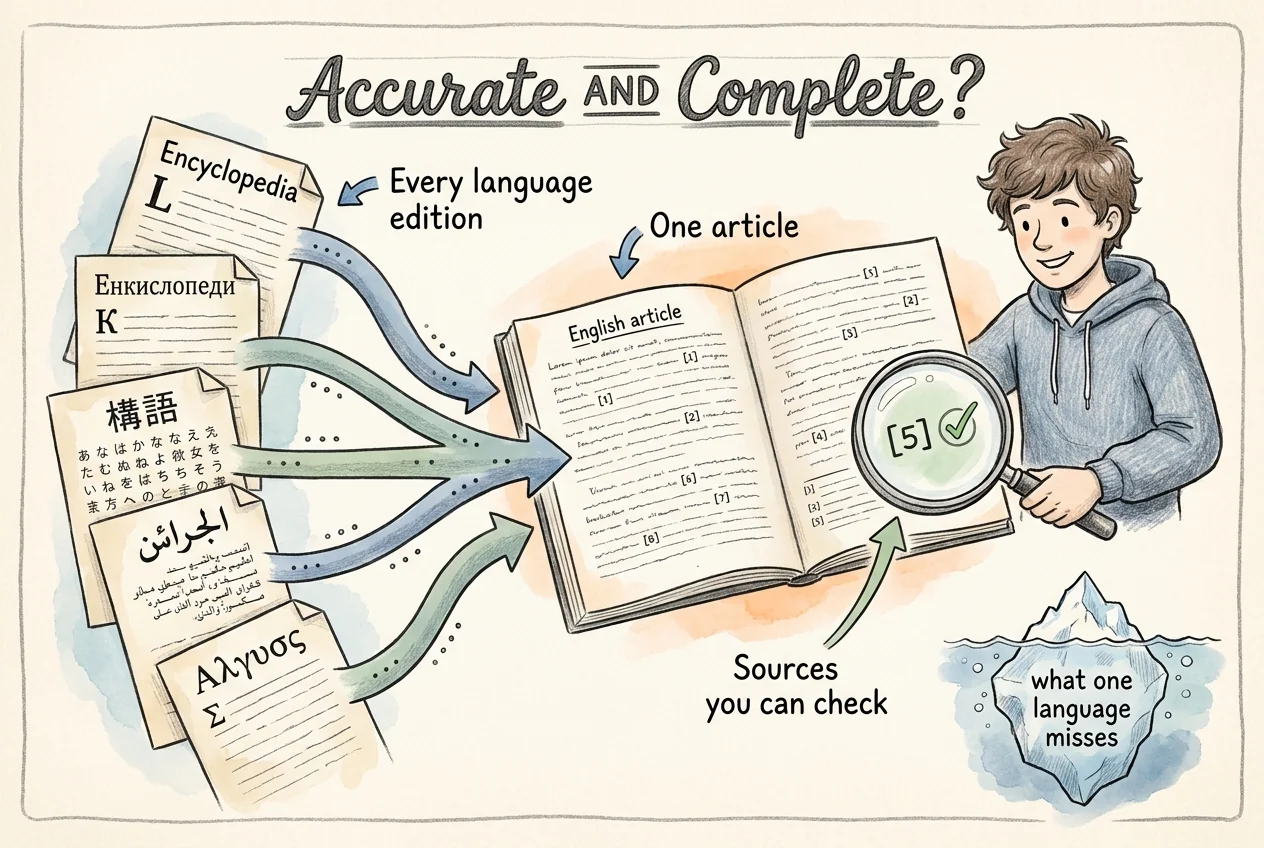
You came here wanting a clean verdict: is SuperCharged Wiki more accurate than Wikipedia, yes or no? It's a fair question, and the useful answer needs a small reframe, because the two sites are not competing on the same measure. Wikipedia's accuracy has been studied extensively, and the findings are more nuanced than its critics or defenders usually admit. SuperCharged Wiki does not set out to catch Wikipedia's errors. It adds content that English Wikipedia has never included, and that distinction shapes every fair comparison between the two.
This article covers two things. First, what peer-reviewed research says about Wikipedia's accuracy, its completeness, and the gap between the two. Second, how SuperCharged Wiki's cross-language approach addresses the problem accuracy studies keep identifying but rarely solve: omission. By the end, you'll have a way to evaluate claims on either site, and a better sense of which one serves your research.
What the Research Says About Wikipedia's Accuracy
The landmark studies and what they found
The most cited accuracy comparison is the 2005 Nature study by Jim Giles, which reviewed 42 science article pairs from Wikipedia and Encyclopaedia Britannica using blind expert review. Wikipedia contained approximately 162 factual errors, omissions, or misleading statements across the sample, compared to 123 for Britannica. That works out to roughly 3.9 errors per article for Wikipedia against 2.9 for Britannica. The study also found eight "serious errors" split evenly between the two, four apiece. The takeaway was that both encyclopedias made mistakes, and the gap between them was smaller than most people assumed.
Medical and scientific domains show a more complicated picture. A 2014 study comparing the Wikipedia articles on the ten most costly medical conditions in the United States with peer-reviewed sources found statistically significant discordance in nine of the ten. A separate pharmacology study reported that German Wikipedia's drug articles were 99.7% accurate against standard textbooks but only 83.8% complete; the English articles it checked were 93.1% complete. An article can be accurate in every sentence it contains and still leave out much of what matters.
Why accuracy alone is the wrong measuring stick
Accuracy and comprehensiveness are different problems. A Wikipedia article can be correct in everything it states while omitting the primary sources, the regional context, the competing scholarly interpretations, and the detailed chronology that would make it useful for research. English Wikipedia's most significant documented weakness is structural omission rather than fabrication, particularly on topics where the relevant expertise and contributors sit in another language community.
This changes what you should look for when evaluating a wiki source. The question is not only "is this wrong?" but also "what's missing, and do I know the topic well enough to notice?" The second question is harder, and it's the one SuperCharged Wiki is built to help answer.
Is SuperCharged Wiki More Accurate Than Wikipedia? First, Consider What's Missing
The language edition problem most readers don't know about
English Wikipedia is the largest by article count, but article count and article depth are not the same thing. German Wikipedia is documented as being more selective in its coverage, rejecting stubs and emphasizing article quality over volume. Comparative analyses of German and English article pairs have found that more than 30% showed greater information coverage in the German edition, though the specific studies producing this figure vary and the number should be treated as an approximate benchmark rather than a precise universal finding. German Wikipedia also classifies scholarly sources differently and tends to produce denser, more fully developed entries on German history, culture, humanities, and engineering topics. Some studies suggest French Wikipedia shows richer coverage of Francophone history and philosophy, and Japanese Wikipedia goes deeper on East Asian history and pop culture, though cross-language audits for those editions are less comprehensive than the German-English comparisons.
These editions are the same Wikipedia project, written by different contributor communities who often carry more subject expertise in certain areas. As a result, the best Wikipedia knowledge on a topic is often spread across several language editions rather than contained in the English version alone.
The reader who loses out
A US student writing about the Franco-Prussian War, a journalist covering Ottoman history, or an educator building a philosophy curriculum around non-Western thinkers all hit the same wall: the English Wikipedia article ends where the German, French, or Japanese version is just getting detailed. They often don't know the richer content exists. Even if they did, reading German or French academic prose isn't a realistic expectation for most English-speaking researchers.
The same problem shows up in personal terms for many US readers. A Mexican-American student researching a specific period of regional Mexican history will find the English Wikipedia article sparse compared to the Spanish edition. A Vietnamese-American reader looking for depth on Vietnamese philosophy faces the same friction. The information exists, locked behind a language barrier that most reference tools do nothing to address.
How SuperCharged Wiki Brings Knowledge Across Languages
The cross-language approach explained
SuperCharged Wiki does not edit Wikipedia. It finds topics where other language editions carry more than the English article, and merges every edition of the topic into one English article. Each paragraph is marked with the editions it comes from, every citation is checked against the edition text it points to, and citations that text does not support are removed. The result is a more complete version of the same global knowledge base, not a separate reference work. No independent audit has yet compared SuperCharged Wiki's coverage or accuracy with Wikipedia's at scale.
This addresses the completeness gap that accuracy studies keep identifying. The pharmacology study's 99.7% accuracy and 83.8% completeness for German Wikipedia shows the problem: what's present is largely reliable, but what's absent is substantial, even if its authors judged much of the missing material not relevant for teaching. SuperCharged Wiki aims to fill that absence rather than re-argue the accuracy of what's already there.
Source attribution as the trust mechanism
Each paragraph of a SuperCharged Wiki article records which language editions it came from, and its citations point to the sources those editions cite. Readers can trace a claim back to its Wikipedia edition and check it there. Instead of asking readers to trust an editorial board they can't see, the site shows the sourcing chain and lets researchers evaluate it themselves.
For students, journalists, and educators who need to justify their sources, that traceability is useful. You can follow a paragraph to the language edition and article it came from, then verify it there. Translation and merging can introduce errors, and no Wikipedia editor has reviewed the result, so check anything that matters against its source.
Topics Where Other Language Editions Run Deeper
Philosophy, history, and internationally focused subjects
The documented cases are specific. Comparisons of German and English articles report that German Wikipedia's articles on topics like historical manuscripts and cultural events are often longer and more detailed than their English counterparts once the relevant expert community develops them. In some cases German Wikipedia splits a single English article into two more detailed entries, with more content, more primary source references, and more analysis.
A SuperCharged Wiki article on the same historical or philosophical topic combines the English and German versions, and every other edition, into a single English article that no individual Wikipedia edition provides on its own. That is what more comprehensive means in practice: content that was always in the global Wikipedia ecosystem, made readable in English in one place.
Heritage communities and culturally specific knowledge
Multiple Wikipedia gap analyses document coverage shortfalls on topics tied to non-Western regions, with identified gaps in cultural context, locally significant historical events, and perspectives from outside the dominant English-speaking contributor base. These gaps aren't random. They reflect the demographics of the Wikipedia editor community, which has historically skewed toward the United States and Western Europe. SuperCharged Wiki treats those gaps as addressable, by bringing in the coverage that already exists in the relevant language edition and making it available in English with attribution.
SuperCharged Wiki vs. Wikipedia: How to Evaluate Any Claim Before You Trust It
The four-step verification approach
Whether you're reading English Wikipedia, a SuperCharged Wiki article, or any other reference source, a consistent verification habit is worth building. The first two steps apply everywhere: check that the specific claim you're relying on carries an inline citation, and confirm that citation links to a verifiable, non-circular source. Then cross-reference any claim that will bear real weight in your work against a primary or peer-reviewed source.
Steps three and four add a cross-language dimension. Compare the article across multiple Wikipedia language editions to check whether key context is missing from the English version. Then, on SuperCharged Wiki, use a paragraph's editions and references to find the originating language edition and verify directly from that source. Together, these four steps address both the accuracy risks and the completeness risks that wiki reliability research consistently flags.
Red flags that indicate a weak article regardless of platform
A few signals apply equally to Wikipedia and SuperCharged Wiki. Uncited claims in body paragraphs are the clearest warning sign. Stale references, citations more than a decade old on fast-moving topics like medicine, technology, or active geopolitical situations, warrant extra caution. Articles with no visible editorial discussion or review history deserve more skepticism than heavily edited ones. Any article that reads as promotional rather than encyclopedic has likely been shaped by an interested party rather than an expert community.
The verification habits are the same across platforms. What changes is what you're verifying for: with Wikipedia, the primary risk is omission; with any wiki, the secondary risk is uncited or weakly cited claims in the body text.
Is SuperCharged Wiki More Accurate Than Wikipedia? The Answer That Actually Helps
Asking whether SuperCharged Wiki is more accurate than Wikipedia assumes the two are competing on the same measure, and they are not. Wikipedia's accuracy, for most topics, is reasonable and extensively studied. SuperCharged Wiki adds a more complete picture by bringing in what English Wikipedia alone doesn't contain, with attribution so you can check the sourcing yourself. No independent head-to-head audit exists, so the honest answer depends on what you're researching and what's at stake if you miss something.
For students, researchers, journalists, and educators working on internationally focused topics, completeness is what matters most. An article that accurately states the few facts English Wikipedia covers is a smaller win than one that covers what the global Wikipedia community has written across all its language editions.
If there's a topic where you suspect richer content exists in another language, check whether SuperCharged Wiki already has it, or request it.