17 Controversial Topics Where Wikipedia's Answer Depends on Your Language
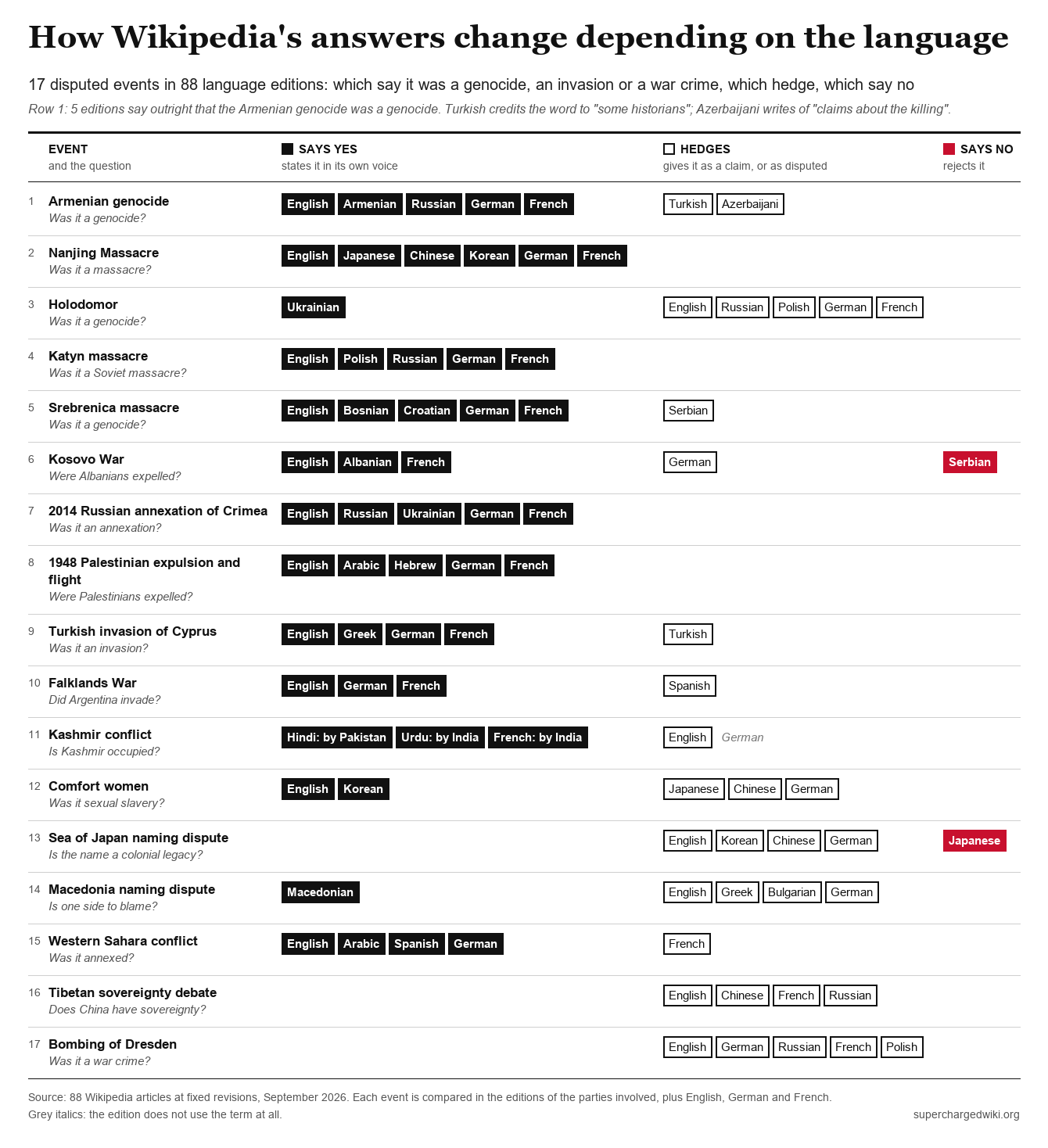
Ask Wikipedia what happened to the Ottoman Armenians in 1915, and the answer depends on the language you ask in. In English, German, French, Russian and Armenian it is a genocide from the first sentence. In Turkish the word belongs to "some historians". In Azerbaijani the article is about "claims about the killing".
16 more topics work the same way. The 1974 landing in Cyprus is "the illegal Turkish invasion" in Greek and the "Cyprus Peace Operation" in Turkish. Argentina invaded the Falklands in English and recovered them in Spanish. Hindi Wikipedia says Pakistan holds part of Kashmir under illegal occupation, and Urdu Wikipedia opens on "occupied Kashmir", with India as the occupier. The bombing of Dresden killed at least 25,000 people in French and up to 25,000 in English, and both cite the same report.
Wikipedia is about 350 encyclopedias, one per language, each written by its own community. I run SuperCharged Wiki, which merges every language edition of a Wikipedia topic into one English article. Merging means putting the editions side by side, and on the events that divide nations they do not tell the same story. So I took 17 of them and compared how each is written in the editions of the parties involved, plus English, German and French as outsiders: 88 articles at pinned revisions, 776,000 English-equivalent words, 15,282 references.
For every article I recorded four things: the name it gives the event, whether it states the central label (genocide, invasion, annexation, occupation, expulsion) in its own voice or hands it to someone else, the figures it puts in its lead and infobox, and where its cited sources come from. The chart above shows the second: which editions say it, which hedge and which say no. Each topic below quotes the sentences that differ, in the original and in translation, and the links at the end of each section go to the exact revisions read.
Three things change with the language
The first is the name. Turkish Wikipedia's article on Cyprus is titled "Cyprus Operation", Hebrew's on 1948 is "The Arabs of the Land of Israel in the War of Independence", Japanese's on Nanjing is "Nanjing Incident", Serbian's on Kosovo is "War in Kosovo and Metohija".
The second is the voice: the same claim is stated as fact in one edition, attributed to "some historians" in a second and rejected outright in a third.
The third is the sourcing. English draws on English-language sources in all 17 articles, and Japanese, Ukrainian and Polish, and German on European events, do the same in their own languages, so the Polish, Russian and German articles on Katyn are built from three different shelves. Many of the smaller party editions do the opposite: the Azerbaijani, Turkish, Armenian, Albanian, Hindi and Urdu articles cite mostly English-language scholarship and change the frame around it.
Two more things matter if you read the English edition. Several editions of the parties are close translations of the English article with the disputed sentences changed, and the outside editions, German and French, take positions of their own.
1. Armenian genocide: genocide in five editions, claims in Azerbaijani
Five of the seven editions call it genocide in their own voice from the first sentence: English ("the systematic destruction of the Armenian people"), German ("war einer der ersten systematischen Genozide des 20. Jahrhunderts"), French ("est un génocide perpétré"), Russian ("геноцид, организованный и осуществлённый") and Armenian.
Turkish titles the article "Ermeni Kırımı" (the Armenian slaughter) and attributes the word genocide to "bazı tarihçiler" (some historians), while stating the deportations, massacres and "etnik temizlik" (ethnic cleansing) in its own voice. Azerbaijani defines its subject as "qətli barədə iddialar" (claims about the killing) and marks its 1.5 million toll "mübahisəli" (disputed).
The Azerbaijani article then contradicts its own lead: its body closely follows the English text, states in its own voice that deportation "faktiki olaraq ölüm hökmünə bərabər idi" (was in effect a death sentence), repeats the English figures and ends on the same sentence about "almost all historians and scholars outside Turkey". Only the frame was changed.
The low end of the death toll depends on the edition. Turkish alone carries Yusuf Halaçoğlu's Ottoman-archive figures of 413,067 deported and 56,610 deaths. German's own-voice range runs "between 300,000 and more than 1.5 million", with the 300,000 credited to Kamuran Gürün. French states about 1,200,000 in its lead with no range.
The Ottoman courts-martial are read in opposite directions: Turkish presents the 1915 to 1916 trials as foremost among "the evidence that the Ottoman state did not pursue a systematic genocide", Russian says the 1919 to 1920 tribunal "held the organised killing of Armenians proven". Turkish has a full section on Turkish and Muslim deaths, with 500,000 to 600,000 killed "it is thought", where English mentions only that Armenian militants killed "thousands of Muslims" in 1918 to 1920.
Editions read: en, tr, hy, ru, de, fr, az.
2. Nanjing Massacre: an incident in Japanese, a massacre in the other five
The Japanese article is titled "南京事件" (Nanjing Incident), and the Korean article says the name is chosen to minimise the event: Japan "calls it an incident, not a massacre, and has reduced the historical facts". Yet the Japanese lead itself says the army "massacred" civilians, prisoners and stragglers; the argument is over the number.
Japanese puts the victims at "about 100,000 to 200,000" and gives 300,000 as the Chinese government's official view. English leads with the Tokyo tribunal's more than 200,000, adds that "newer estimates adhere to a death toll between 100,000 and 200,000", and says modern historians consider 300,000 "an overestimate". Chinese gives "200,000+ to 300,000" on the authority of the Tokyo and Nanjing tribunals and says the 300,000 figure "has become a symbol" of China's suffering.
Korean contradicts itself: its lead says about 200,000 citing the Tokyo tribunal, a later section says the tribunal concluded 150,000, and its body gives 500,000 to 600,000 in its own voice, the highest number any edition states, cited to Iris Chang.
Responsibility is taken to the emperor in German and French: German says flatly that Hirohito "explizit den Befehl" gave not to apply the Hague Convention to Chinese prisoners; French calls his approval of such a directive "one of the most plausible explanations". Chinese command failures get the most space in Korean, French and Chinese, including the mainland view that Nationalist "無能作為" (incompetence) was an important cause of the casualties.
Editions read: en, ja, zh, ko, de, fr.
3. Holodomor: only Ukrainian calls it genocide in its own voice
Only Ukrainian states genocide in its own voice: "Голодомор був геноцидом українського народу" (the Holodomor was a genocide of the Ukrainian people). English says it "remains in dispute whether the Holodomor was intentional, whether it was directed at Ukrainians, and whether it constitutes a genocide", German "Diese Bewertung ist umstritten", French "le caractère génocidaire de cette famine est contesté".
Russian reports no consensus and adds that a third group of scholars, "including all Russian scholars", deny that the genocide reading is legitimate; Ukrainian in turn names Russia's official circles as "the main apologists of Holodomor denial".
The editions agree the famine was man-made and disagree on how to say so: Polish writes that among researchers of the famine "there is no doubt that the famine of 1932 to 1933 in Ukraine was artificial", German frames the debate as whether the catastrophe was the "Zweck oder Folge" (purpose or consequence) of Stalinist policy, and French quotes Wheatcroft and Davies calling it "an accidental consequence of badly designed policies". Polish titles its article "Wielki głód na Ukrainie" (Great Famine in Ukraine) rather than Holodomor, and Russian captions its recognition map "т.н. голодомор" (so-called Holodomor).
The same 2013 Ptukha Institute figure of 3,917,800 excess deaths in Ukraine appears in Ukrainian, Russian and Polish, but only Russian puts the republic-by-republic table in its lead, showing Kazakhstan's relative loss (22.4%) above Ukraine's (12.9%). Headline tolls run from French's floor of 2.6 million to infobox ceilings of 10.5 million in Ukrainian and 12 million in Polish, both unattributed.
Editions read: en, uk, ru, pl, de, fr.
4. Katyn massacre: five editions agree on the killers and split on genocide
All five editions state the crime and its authors as fact: NKVD executions ordered by Stalin and the Politburo in spring 1940. The Russian article, titled "Катынский расстрел" (the Katyn shooting), calls it "военное преступление" (a war crime) in its first sentence and says the Russian military prosecutors' investigation proved that the documents the Soviet Burdenko commission produced were "the product of direct falsification".
The split is over the word genocide. The Polish infobox gives "typ ataku: ludobójstwo" (type of attack: genocide) without qualification; Russian mentions genocide only as a version its military prosecutors found "не подтвердившейся" (unconfirmed); English attributes it to a 2009 Sejm resolution (the crime "bears the hallmarks of a genocide"), German to "viele Historiker" (many historians) and French to the Polish Senate.
German is the only edition whose lead counts the Katyn forest site alone, about 4,400 shot there, where English, Polish and Russian lead with the whole operation of nearly 22,000. The chief executioner Blokhin's personal toll differs by an order of magnitude, 7,000 in English against about 700 in Russian, which the readings could not reconcile. Russia's return since 2022 to blaming the Germans is covered by English, Russian and German; the French article says nothing after 2011.
Editions read: en, pl, ru, de, fr.
5. Srebrenica massacre: several thousand dead in Serbian, at least 8,372 in Croatian
Bosnian, Croatian and French title the article genocide; English, German and Serbian title it a massacre, though English and German call it genocide in their own voice. The Serbian lead calls the killings a massacre of "неколико хиљада" (several thousand) men, "first of all prisoners of war", says only "part of the public" knows it as genocide, introduces the 8,372 on the memorial stone with "наводно" (allegedly), and says the courts found that "Serbia is in no way responsible".
The Croatian lead says "at least 8,372" Bosniak men and boys were killed and names "the special Serbian military unit Scorpions" among the killers; Bosnian says the Scorpions acted "under the control of Serbia's Interior Ministry".
The Kravica warehouse killings of 13 July show how one event becomes two: English, Bosnian and Croatian give 1,000 to 1,500 men taken there, Serbian heads the Kravica shooting "a separate incident", says a special police unit of 15 to 20 men shot "between 270 and 300" prisoners there, and treats it as isolated from the other executions. The revenge motive runs the other way: English says the revenge claims "have been rejected and condemned" by the tribunal and the UN, while Serbian gives a full background section to Bosnian army crimes against Serbs in the Podrinje.
Editions read: en, bs, sr, hr, de, fr.
6. Kosovo War: expelled in three editions, fled in Serbian
English, Albanian and French open with the same sentence: on 20 March 1999 Yugoslav forces began "a massive campaign of repression and expulsions of Kosovar Albanians", and all three state in their own voice that 1.2 to 1.45 million Albanians were displaced.
Serbian, titled "War in Kosovo and Metohija", says that before 24 March 1999 "there was no systematic ethnic cleansing", records about 800,000 Albanians who fled during the NATO bombing without saying they were expelled, and gives as its expulsion figure the roughly 200,000 Serbs, Roma and others who left after the war. The 2001 UN-administered court's finding against genocide is reported by four editions, but Serbian restates it as the finding that Yugoslavia "did not try to eradicate the Albanian population, therefore there was no genocide".
The outside editions take sides of their own. German says in its own voice that NATO justified its war "unter Bruch des Völkerrechts" (in breach of international law) and gives about 3,500 dead from the bombing on the authority of Tanjug, the Serbian state agency, where English's lead has "at least 488" from Human Rights Watch. French uses the phrase ethnic cleansing by name only for the KLA's treatment of Serbs and Roma.
German also shifts on Račak: "das zuvor verübte Massaker" (the massacre previously committed) in its own voice near the start, "das angebliche serbische Massaker" (the alleged Serbian massacre) later, in a passage relaying a newspaper's account of the Finnish forensic report.
Editions read: en, sq, sr, de, fr.
7. 2014 Russian annexation of Crimea: most Crimeans wanted it in Russian, a falsified vote in Ukrainian
All five editions, Russian included, title the event an annexation. Russian's first sentence rests on non-recognition ("was not recognised by most of the international community") rather than a legal verdict, and elsewhere its lead says that "with the seizure of Crimea, Russia began the undeclared Russo-Ukrainian war".
The dispute is over the people. Russian says in its own voice that "the majority of the peninsula's population wanted to become part of Russia"; Ukrainian says the referendum results and turnout were "повністю сфальсифіковані" (completely falsified) and puts real turnout at about 30%, citing a report of Putin's own Human Rights Council, which German gives as 30 to 50% turnout with 50 to 60% in favour.
French alone questions the UN General Assembly's resolution in its own voice, saying it "is not legally founded on international law"; German states that "annexations have been contrary to international law since 1945".
The one civilian killed in March 2014, Reshat Ametov, is not named in the body of any of the five articles; German gives the fullest account, citing Human Rights Watch, without naming him.
Editions read: en, ru, uk, de, fr.
8. 1948 Palestinian expulsion and flight: a Hebrew title without Palestinians
Hebrew is the only edition whose title names neither expulsion, flight nor the Palestinians: "ערביי ארץ ישראל במלחמת העצמאות" (The Arabs of the Land of Israel in the War of Independence). English and German title it expulsion and flight, Arabic "تهجير" (forced displacement), French "exode".
The label ethnic cleansing is weighted four ways: English says "scholars widely describe the event as ethnic cleansing, although some disagree", Arabic "many historians", German "by some historians", French attributes it to Ilan Pappé by name, and Hebrew uses the term only in the titles of its further reading, never in its own text.
Hebrew is by far the shortest article, 1,766 English-equivalent words on 12 notes, ten of which cite Benny Morris, and it names no Palestinian or Arab historian; English has 149 references, Arabic 142, German 135. Hebrew is also the only edition that counts Jewish dead in the cycle of attack and reprisal.
On Lydda and Ramle, Arabic and German state in their own voice that the 60,000 inhabitants were expelled "on the orders of David Ben-Gurion and Yitzhak Rabin"; Hebrew gives "about 50,000 to 70,000" expelled with no citation. German and Arabic follow the English article almost heading for heading, so agreement among those three is one article in three languages, not three witnesses.
Editions read: en, ar, he, de, fr.
9. Turkish invasion of Cyprus: illegal invasion in Greek, peace operation in Turkish
The Greek article opens with two words of judgment, "Η παράνομη Τουρκική εισβολή" (the illegal Turkish invasion). The Turkish article is titled "Kıbrıs Harekâtı" (Cyprus Operation), calls it the "Cyprus Peace Operation" in its body and infobox, never uses invasion or occupation in its own voice, assigns "occupation" to the UN and the Council of Europe, and says the first operation "can be regarded as a lawful intervention within the framework of the treaties".
German dates the occupation "in violation of international law" from 14 August; English uses the passive, "is viewed as illegal under international law". On crimes against Greek Cypriots, Turkish alone shifts the blame: "most of the violations were committed not by Turkish soldiers but by Turkish Cypriots in military uniform mistaken for Turkish soldiers".
The displacement figure runs from 120,000 to 210,000 depending on which edition and which source, and the Turkish military losses in every edition lead back to one Turkish-language book, Haydar Çakmak's history of Turkish foreign policy, whose 498 dead appear in the Turkish body and the German and French infoboxes. Only English gives a number for settlers from Turkey ("over 120,000", Council of Europe); the Turkish, German and French articles do not mention settlers at all.
Editions read: en, tr, el, de, fr.
10. Falklands War: invaded in English, recovered in Spanish
English, German and French state as fact that Argentina invaded ("Argentina invaded", "Annexion", "d'envahir les îles Malouines"). Spanish writes in its own voice "La recuperación argentina de las Malvinas" (the Argentine recovery of the Malvinas), though its own Operación Rosario section also calls the landing an invasion.
Spanish is the only edition to put outside backing for Britain in its first sentence, "con el respaldo de la Organización del Tratado del Atlántico Norte" (with the backing of NATO), and gives Chile's help to Britain four subsections; the German article mentions Chile only in a footnote.
The lead death toll agrees in English and Spanish (649 Argentine, 255 British, 3 islanders) but not elsewhere: French gives 907 with 258 British in the lead and 255 in its losses section, German says "about 900 dead" and then gives two different pairs of figures without reconciling them. Veteran suicides are counted for different sides: English gives only British figures, French only Argentine ones, Spanish and German both.
Editions read: en, es, de, fr.
11. Kashmir conflict: Hindi and Urdu each name the other side as occupier
The two editions of the languages most directly involved assign the occupier role to opposite states. Hindi says in its own voice that the accession covered "the area under Pakistan's illegal occupation" (पाकिस्तान के अवैध कब्जे वाला क्षेत्र); Urdu's first sentence calls the disputed region "مقبوضہ کشمیر" (occupied Kashmir), contested by "Kashmiri freedom fighters".
Only French applies occupation language to the Indian army in its own voice ("it acts like an army of occupation"); English keeps it inside attributed clauses and German uses "under Indian control" throughout, with militants as "Terroristen" in its casualty table.
The 1947 violence against Muslims in Jammu is "20,000 to 100,000" massacred in Urdu, "a large number" in English, and absent from Hindi, whose only 1947 killings are in Pakistan-administered Kashmir, where "rivers of blood were made to flow". The Kashmiri Pandit exodus is "more than about 7 lakh" (700,000) in Hindi, uncited, a spread of attributed figures from 140,000 to nearly 400,000 in English, and not mentioned in Urdu, German or French.
Urdu makes an ethnic generalisation in its own voice, in a passage on Nehru and Kautilya: "چالاکی اور فریب کاری ہندوؤں کی فطرت کا حصہ ہے" (cunning and deceit are part of the nature of Hindus), with no counterpart in any other edition. Hindi runs to 13 references, Urdu to 18, French to 5; the English article has 592.
Editions read: en, hi, ur, de, fr.
12. Comfort women: sex slaves in Korean, prostitution in Japanese
The label splits three ways. Korean says in its own voice "단도직입적으로 말하면 성노예였다" (put bluntly, they were sex slaves). English says the women were "forced into sexual slavery". German says they were "zwangsprostituiert" (forced into prostitution) and uses "Sexsklaven" only as the Korean Council's term. Chinese hedges: "widely regarded as organised sexual slavery".
Japanese defines them as women "made to engage in prostitution" (売春をさせられた女性), adds that "some were taken by force", and assigns the sexual-slavery definition to the United Nations, several parliaments, the Korean and Taiwanese governments and "international society".
Japanese is also the only edition that carries an outside criticism of Wikipedia itself, quoting the historian Chelsea Szendi Schieder that revisionist denial is influential online, "including Japanese Wikipedia".
The headline number differs: English and German give 20,000 to 200,000, Japanese the widest range, 20,000 to 410,000, Korean a single 200,000 with no citation marker, Chinese "数十万" (several hundred thousand) in its own voice. Korean complicity is carried most heavily by Korean, which states that nearly 200,000 women "could not have been mobilised without the assistance of Koreans" and that the Koreans who procured them were never punished.
Editions read: en, ja, ko, zh, de.
13. Sea of Japan naming dispute: Japanese Wikipedia rules against Korea
Only Korean names the article after the Korean term, "동해의 이름에 대한 논쟁" (Dispute over the name of the East Sea); English, Japanese, Chinese and German title it after the Sea of Japan.
English, Korean and Chinese state the colonial context of the 1929 naming in their own voice ("while Korea was under Japanese colonial rule"); German reports it only as what "the Korean governments claim"; Japanese attributes it to Korea and then rejects it: after reviewing Korea's old-map surveys it states, without saying who concluded it, that the Korean claims resting on them have been found to have "no basis" (根拠がない), the only edition that rules against one side outright.
The same 2020 decision of the International Hydrographic Organization is a Japanese victory in one edition and a compromise in another: Japanese records that "the IHO approved Sea of Japan as the sole designation", German that the new standard uses "only numerical identifiers". Japanese and Korean report the same rise in dual naming on world maps and credit opposite causes, Japanese to VANK-backed "propaganda" and Korean to persuading experts "with scholarly logic and evidence". Japanese gives Korean activism 24 of its 58 headings, including a section on protest emails it calls "cyber-terror attacks".
Editions read: en, ja, ko, zh, de.
14. Macedonia naming dispute: a ruling against Greece in Greek, a pending case in Macedonian
Only the Macedonian edition puts the cause of the dispute in its own voice: the dispute "во главно, е плод на несогласувањето на Република Грција да го прифати уставното име Македонија" (is mainly the fruit of the Republic of Greece's refusal to accept the constitutional name Macedonia). English, Greek, Bulgarian and German all attribute the charge to Greece, German in the reported-speech subjunctive.
The Greek article reports that Greeks call the dispute "Σκοπιανό" (the Skopje issue), calls the neighbouring state a statelet ("κρατιδίου" in its account of the name talks) and refers in its own voice to "the nationalist propaganda of the Gruevski government"; the Macedonian article says such terms "are regarded as extremely insulting". The Greek and German editions also name Greek nationalism in their own voice: Greek says the issue brought "the revival of nationalist discourse in Greece", German that "nationalist and far-right groups" called the 2018 Thessaloniki rally.
The 2011 International Court of Justice ruling is settled in three editions and missing in two: English gives it as 15 to 1, Greek says the court "καταδίκασε την Ελλάδα" (condemned Greece) for its statements at the Bucharest summit, German says the NATO veto breached the 1995 accord, while Macedonian still describes the lawsuit as pending and Bulgarian, a 625-word stub, does not mention it.
Only Bulgarian treats the dispute as partly its own, writing of "така нареченият „македонски език“" (the so-called Macedonian language) on the authority of the Bulgarian Academy of Sciences.
Editions read: en, el, mk, bg, de.
15. Western Sahara conflict: occupation in German and Spanish, control in Arabic
German and Spanish state Morocco's takeover as occupation in their own voice ("militärische Besetzung", "la ocupación marroquí"). English only attributes it ("the SADR government considers the Moroccan-held territory to be occupied"). The Arabic article does not contain the word احتلال (occupation) at all and calls present Moroccan rule "control".
French uses occupation only for Spain ("l'occupation espagnole"), dates the conflict to 1957 under Spanish rule, and calls UN Resolution 2797 "a notable diplomatic victory for Morocco"; German closes on the same resolution and adds that several EU states, Germany among them, do not recognise Moroccan sovereignty.
English, Arabic and Spanish open with the same sentence about the 1976 annexation by Morocco and Mauritania, another case of one article in three languages. Only German describes the 1975 International Court of Justice opinion on self-determination.
Editions read: en, ar, es, fr, de.
16. Tibetan sovereignty debate: invaded, intervened in or entered
The four editions describe 1950 in four registers. English: "the People's Liberation Army invaded Tibet". French: "l'intervention militaire chinoise" (the Chinese military intervention), with "invasion" given to the exile government. Russian heads the event "Establishment of PRC power in Tibet" and narrates that the army "entered Tibet". Chinese, uncited, says the PRC "繼續對西藏的侵略" (continued the invasion of Tibet).
English and French read the 1960 report of the International Commission of Jurists in opposite directions: English quotes it finding no sufficient proof of the destruction of Tibetans as a group, French says it found China "was committing an act of cultural genocide".
English, French and Russian state in their own voice that every state recognises Tibet as part of China; Chinese instead reads Nepal's 1949 UN filing as proof of recognition of Tibet's independent sovereignty. Chinese alone judges the migration policy in its own voice, saying the policy of moving Han into minority areas "also seems to have succeeded". Russian draws 82% of its references from Russian works, 49 of them from a single history.
Editions read: en, zh, fr, ru.
17. Bombing of Dresden: at least 25,000 dead or at most 25,000
All five editions cite the same source for the death toll, the Dresden commission of historians that reported in 2010, and word its result differently: French's lead says the raids killed "au moins 25 000 personnes" (at least 25,000) and Russian's infobox gives more than 25,000, while English gives "up to 25,000", German 22,700 to 25,000 and Polish about 18,000 and not more than 25,000. A floor in two editions is a ceiling in three.
Russian is the only edition whose lead offers an intent reading, that "a number of historians" say the raid served "to intimidate the Soviet leadership", and it says that because official documents contain no Soviet mention of Dresden, researchers file claims that the USSR demanded the raid under "Cold War propaganda", where English puts the Soviet request in its decision chain.
Only German counts Dresden's Jews: about 40 killed by the bombs and about 70 of the 198 scheduled for deportation on 14 to 16 February who escaped in the chaos. Only Polish sets Dresden beside Warsaw, quoting a former Wehrmacht soldier on 40,000 dead under the rubble of Warsaw in 1939: "and then let the word freeze on our lips: Dresden".
Editions read: en, de, ru, fr, pl.
Whose sources each edition cites
Most of the large editions build their articles from sources in their own language, and some articles lean on a single book.
- On the Armenian genocide, English draws 92% of its 344 references from English-language academic work and cites no Turkish- or Armenian-language source at all; Turkish is 42% Turkish sources including state archives; German is 61% German-language, including Foreign Office files; Armenian and Russian share an outline and long passages, including an identically worded section on disputed questions.
- On Nanjing, Japanese is 79% Japanese-language, Chinese 53% mainland Chinese-language, English 86% English-language Western. Korean rests 12 of its 27 references on one book, Chang's The Rape of Nanking, which Japanese flags for exaggeration.
- On Katyn, Polish is 89% Polish-language, French 73% French, English 67% English, Russian 66% Russian, German 61% German, with one German study, Claudia Weber's Krieg der Täter, behind about 84 of its notes.
- On Srebrenica, German draws 64% of its references from German-language press and scholarship, French 42% from French sources, Serbian 32% from Serbian and Republika Srpska sources; English's largest block is court and UN documents (34%), with Serbian sources at 4%.
- On the Falklands, English draws 73% of its 305 references from the United Kingdom and German 62% of its 310 from British sources; Spanish draws 64% of its 192 from Argentina, 62 of them from one book.
- On comfort women, Korean draws 83.5% of its references from Korean-language sources and Japanese 58% from Japanese; English's largest block is US outlets (42%).
Method and caveats
Each article was read in full in its own language at a fixed revision, linked above, in September 2026; for each I recorded the name used, the treatment of the central label, every figure in the lead and infobox with its attribution, the section headings, the size and origin of the reference list, and quotations, with the quotations checked against the saved text.
The chart places each edition by its treatment of the label: stated in the edition's own voice (says yes), attributed to others or presented as disputed (hedges), or rejected (says no), with an edition that never uses the term shown in grey. The data file keeps attribution and dispute apart.
Thirteen of the 88 readings were marked medium rather than high confidence (Turkish and Azerbaijani on the Armenian genocide, German on Katyn, English and French on the Kosovo War, English on 1948, Spanish on the Falklands, English and Korean on the Sea of Japan, Greek on the Macedonia dispute, English and French on Western Sahara, and Chinese on Tibet), and figures from those articles should be checked against the linked revisions before being quoted further.
Three limits apply to everything above. Source-origin shares are classifications of each reference list by publisher country or language, rounded, with category boundaries that differ between editions, so compare them roughly. Statements that an edition does not mention something are judgments from reading the article, not exhaustive searches.
Translation can introduce artefacts: the Russian phrase for "final decision" can also be read as "final solution", the Turkish "Kırım" can be rendered slaughter or massacre, and a few figures differ between editions in ways that look like transcription errors rather than positions (a Blokhin toll of 7,000 in English against 700 in Russian; 640 shops destroyed in Dresden in English against 6,470 in Russian).
Where an edition is short, its silences reflect its length as much as its stance: the Bulgarian article on the Macedonia dispute is 625 words, the Polish article on Dresden 529, the Hebrew article on 1948 1,766.
Data: the full comparison records (JSON: per topic, the label judged and one row per edition with name, treatment, headline figure, section count, word count and source mix, plus the sharpest contrast for each topic). Revisions are pinned in the links under each section.