Which Language Edition of Wikipedia Is the Most Detailed?
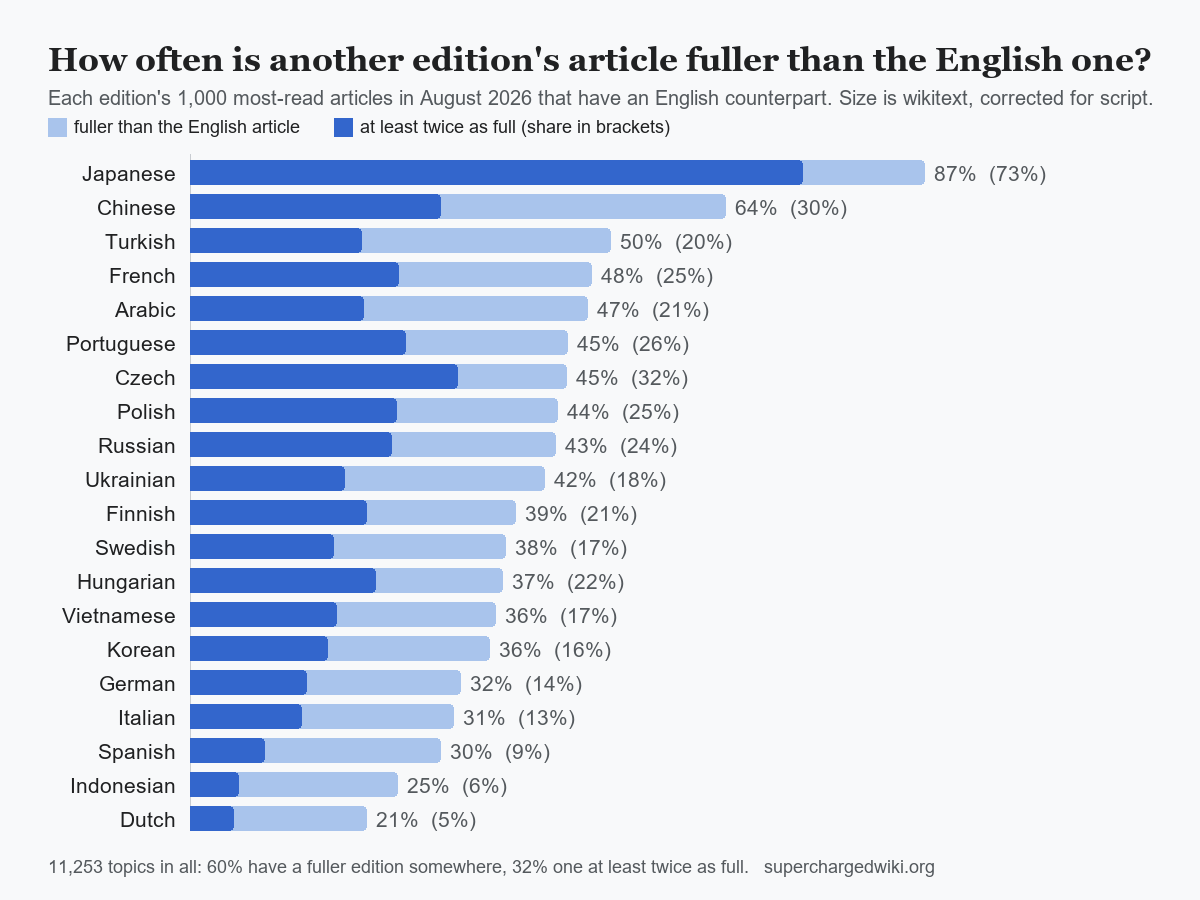
English Wikipedia is the largest edition by article count, so it is easy to assume it is also the fullest on any given topic. It often isn't. To put a number on that, SuperCharged Wiki took the 1,000 most-read articles of August 2026 in each of 20 language editions, matched each one to its English counterpart, and compared their sizes. The data file is linked at the end.
The headline numbers
The 20 editions were German, French, Spanish, Italian, Portuguese, Russian, Japanese, Chinese, Polish, Ukrainian, Dutch, Swedish, Czech, Finnish, Hungarian, Turkish, Korean, Arabic, Indonesian and Vietnamese. Their top-1,000 lists resolve to 11,253 distinct topics that have an English article. Of those:
- 60% (6,793 topics) have at least one edition fuller than the English article.
- 32% (3,596 topics) have an edition at least twice as full.
- 1,000 topics have an edition at least five times as full, and 281 have one at least ten times as full.
- A further 2,411 articles in these top-read lists have no English article at all.
So for a topic that is widely read somewhere in the world, the English article is the fullest version only two times in five.
Which editions are fuller, and how often
The chart above answers the question edition by edition: of each edition's 1,000 most-read articles with an English counterpart, how many are fuller than the English one, and how many are at least twice as full.
- Japanese leads by a wide margin: 87% of its most-read articles are fuller than the English version, and 73% are at least twice as full.
- Chinese (64%), Turkish (50%), French (48%), Arabic (47%), Czech (45%), Portuguese (45%), Polish (44%) and Russian (43%) each beat English on close to half of their most-read topics.
- German comes out lower than its reputation, at 32% fuller and 14% at least twice as full, with Italian (31%), Spanish (30%), Indonesian (25%) and Dutch (21%) below it.
Counted the other way, among the 3,596 topics with a big gap, the fullest version is Japanese for 524 of them, Czech for 256, Chinese for 246, Portuguese for 236, French for 225, Polish for 219 and Russian for 217. Every one of the 20 editions holds the fullest version for at least 44 topics.
A likely reason German ranks low here is what its readers read. German Wikipedia's most-read articles are largely global topics that English covers well. The depth German is known for shows up on German history, German towns and German institutions, and those rarely make a top-1,000 list. The same goes for Dutch and Spanish. Japanese ranks high for the mirror-image reason: much of what Japanese readers read most is Japanese television, manga and domestic history, which English Wikipedia covers in a paragraph or two.
What the gaps look like up close
The measurement above is rough, because it works from raw article sizes. For the 67 topics SuperCharged Wiki has built so far, the comparison is exact: the text of every edition as a reader sees it, headings, lists and tables left out, corrected for script. These topics were chosen because they had gaps, so they show how large gaps get rather than how common they are.
Of the 67, 57 have an edition at least twice as full as the English article and 29 have one at least five times as full. On the median topic, five different editions are fuller than English. The largest gaps:
- First Saudi State: the Arabic article carries 52 times the English text.
- Kalashnikov rifle: German, 40 times.
- Crow: Japanese, 32 times.
- Bayezid II: Arabic, 29 times.
- Ptolemaic dynasty: Japanese, 18 times.
- Murad II: Arabic, 15 times.
- Bovinae: Hungarian, 15 times.
- Kingdom of Portugal: Portuguese, 10 times.
- Anubis: French, 9.5 times, with 91 editions in all.
- Crustacean: Portuguese, 9.3 times.
The pattern is not that one edition is best. It is that the fullest article on a topic tends to sit in the language community closest to it: Arabic for the Saudi state and the Ottoman sultans, Portuguese for Portugal, Hungarian for cattle breeding, Finnish for a dog breed bred in Finland, Japanese for the natural history of a bird the Japanese edition treats at book length.
How this was measured
The broad study used the size of each article's wikitext in bytes, as recorded by Wikipedia. Bytes are not comparable across scripts: a Russian character takes about 1.5 bytes and a Japanese one about 2.2, and a Japanese character also carries more meaning than a Latin one. Sizes were therefore converted to characters using a bytes-per-character figure for each script, then to English-equivalent characters using a factor for each language measured on one text that exists in every language, the Universal Declaration of Human Rights, whose English version is 10,705 characters long. That gives Japanese 2.52, Chinese 3.21, Korean 2.25, Arabic 1.34, Czech 1.09, Russian and Ukrainian 1.00, Polish 0.95, Portuguese 0.91, French, Spanish and Italian 0.90, and German and Dutch 0.83.
The exact study on the 67 built topics used the rendered text of every edition at a fixed revision, with headings, lists, tables, infoboxes and reference lists removed, converted with the same language factors.
Checking one against the other on those 67 topics, the rough method named the same fullest edition for 52 and agreed on whether the gap was at least twofold for 58. Where it differed, it usually understated the gap: the rough figure was on median 0.81 of the exact one, because English wikitext carries heavy citation markup that counts as size without being text. The broad numbers above are, if anything, conservative.
What "fuller" does and does not mean. Fuller means more text. It does not mean better: an article can be long because it lists every episode of a television programme, and a short article can be the more accurate one. The point of the measurement is narrower than a quality judgment: it shows how often an English reader is looking at a version that leaves out most of what the encyclopedia holds on the topic.
Limits. The study covers August 2026 only, and only articles that reached a top-1,000 list in one of 20 editions, so it says nothing about the long tail. Nine editions with large communities (Persian, Hebrew, Norwegian, Danish, Catalan, Greek, Romanian, Thai and Hindi among them) were not included. The language factors are single measurements on one text, and Japanese in particular moves with its factor.
What to do with this
If you read only English and the topic has a strong tie to another country or language, open the "Languages" panel on the Wikipedia article and look at the size of the other versions. Browser translation will get you the facts even when it mangles the prose. For the topics SuperCharged Wiki has built, the work is already done: each article is written from every edition, with each paragraph marked by the editions it comes from and every citation checked against the edition text it points to. If you know a topic where another edition runs far deeper, request it.
Data: the per-edition table and the 67-topic measurements (CSV). Article sizes and view counts come from the Wikimedia APIs; the research scripts and the site's articles are published under CC BY-SA 4.0.